
START HERE
Read this in 60 seconds.
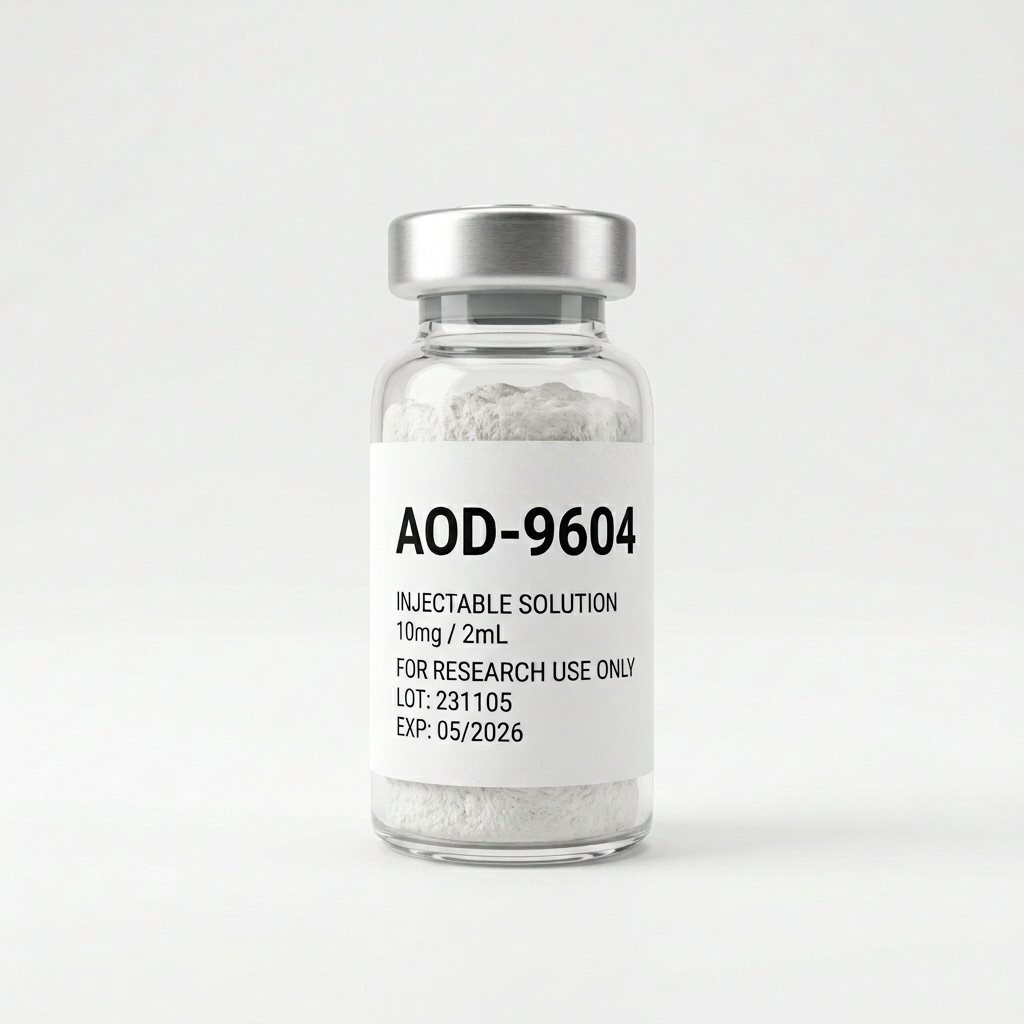
AOD-9604 is a fragment of growth hormone marketed as a fat-burning peptide that doesn't carry growth hormone's downsides. The animal research is genuinely interesting. The human story is more complicated — the largest trial designed to confirm fat loss came back negative.
YOU'LL LEARN, IN ORDER
- Is the science good?Mixed, small trials
- Does it work?Safer than effective
- The short versionTL;DR
- Should I take it?Honest answer
- Where this is from7 studies
How we got to that verdict.
You've probably seen AOD-9604 described as a fat-burning peptide that gives you the weight loss benefits of growth hormone without any of the downsides — no blood sugar problems, no unwanted growth effects, just cleaner fat metabolism. You may have also seen people online say the evidence is weak, or that it's just another supplement with overhyped claims.
The truth sits somewhere between those two positions, and it's worth understanding exactly where. This page walks through every major claim about AOD-9604 using the actual published research — including the parts that didn't go the way anyone hoped.
The research journey
Every medical treatment — aspirin, penicillin, the cholesterol medication your dad takes — starts in a lab, then gets tested in animals, then in small groups of people, then in larger trials, and finally goes through a formal approval process before it can be marketed as a treatment.
AOD-9604 has traveled partway down that road. It started in rat and mouse studies in the 1990s 1, moved into small human trials in the early 2000s 5, and eventually reached a 300-person randomized controlled trial and a larger 500-person trial 4. It has never received regulatory approval as a treatment for obesity or any other condition, and the larger human trial did not confirm the positive results seen in smaller studies. That's an important fact we'll come back to.
Animal research is how all medical inquiry starts — aspirin, penicillin, and every drug you've taken went through this stage. But fewer than 1 in 10 animal-tested compounds ever make it through to regulatory approval for humans. That's not a reason to dismiss animal results. It's a reason to treat them as a promising start that needs confirmation, not a finished proof.
Right now, AOD-9604 sits between the Small Human Trials and Large Human Trials stages — with the caveat that the larger trial produced a null result, meaning it didn't prove the compound works for fat loss.
The honest bottom line
AOD-9604 has a genuinely interesting scientific rationale, a promising set of animal studies, and reasonable short-term human safety data. What it does not have is convincing human evidence that it actually reduces body fat — the largest trial conducted specifically to answer that question came back negative, and that result has never been overturned.
The safety data is more reassuring than the efficacy data, which creates an unusual profile: a compound that appears unlikely to cause certain specific harms, but where the evidence that it produces the benefit people are seeking is thin. If you're considering AOD-9604, the safety-versus-efficacy gap is exactly the conversation worth having with a qualified provider — one who can weigh it against your individual goals, your baseline health, and what the research actually can and cannot tell us.
Sources
- Inhibition of lipogenesis by a synthetic peptide of human growth hormone (1993, Monash University lab study, rat fat tissue)(1993)
- Effects of human GH and its lipolytic fragment (AOD9604) on lipid metabolism in obese mice and beta-3-AR knockout mice(2000)
- AOD-9604 mechanism studies via the beta-3 adrenergic receptor pathway (rat/mouse, Monash group)(2001)
- OPTIONS Phase 2b trial — 500-person, 24-week RCT (Metabolic Pharmaceuticals; results released 2007 via corporate disclosure, never peer-reviewed)(2007)
- 300-person 12-week Phase 2 RCT (Metabolic Pharmaceuticals; results released 2004 via corporate press release, never peer-reviewed)(2004)
- Safety and tolerability of AOD-9604: a pooled analysis of six clinical trials (~925 participants)(2013)
- FDA GRAS Notice GRN 326 — AOD-9604 Generally Recognized As Safe for use as a food ingredient(2010)
Some links above point to PubMed search results rather than direct study pages where the original publication wasn't indexed (mostly for the company press releases that were never peer-reviewed). When that happens, the search query is scoped to the specific compound and topic.