
START HERE
Read this in 60 seconds.
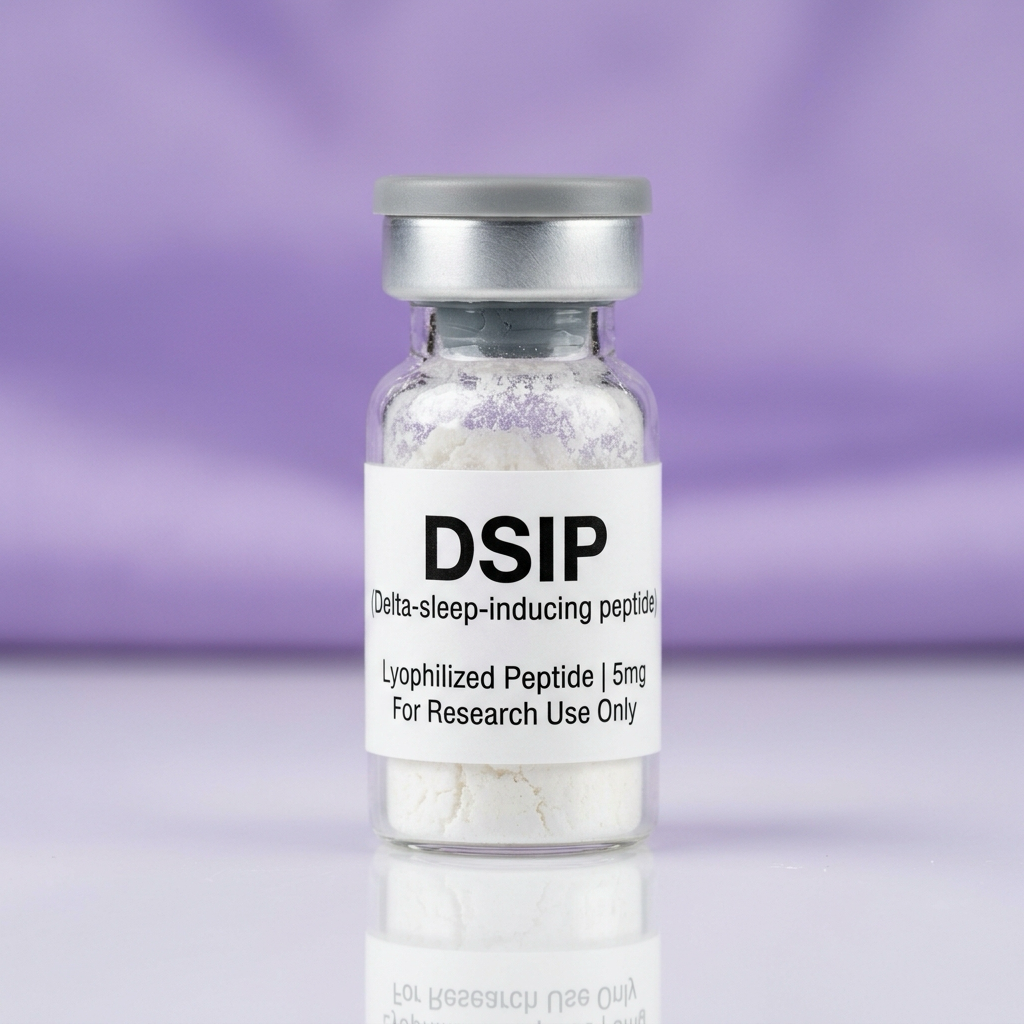
DSIP (Delta Sleep-Inducing Peptide) is a peptide discovered in the blood of sleeping rabbits in the 1970s. The original research produced signals worth noticing, but the small human trials of the early 1980s were never followed by the larger studies that would have confirmed or disproven them. Honest framing: more interesting than the skeptics admit, more limited than the enthusiasts want you to believe.
YOU'LL LEARN, IN ORDER
- Is the science good?Stalled at small trials
- Does it work?Promising, not proven
- The short versionTL;DR
- Should I take it?Honest answer
- Where this is from8 studies
How we got to that verdict.
You've probably come across DSIP on Reddit threads about peptide stacks, TikTok videos promising "the deepest sleep of your life," or a wellness provider who mentioned it as a natural alternative to sleep medication. You may have also seen people push back hard, saying the research is thin or that it's all hype.
Here's the honest truth: neither side is completely right. The evidence for DSIP is more interesting than the skeptics admit, and more limited than the enthusiasts want you to believe. Let's walk through what the research actually shows, claim by claim, so you can make up your own mind.
The research journey
DSIP sits at the Small Human Trials stage — which sounds more reassuring than it is, because the human trials that exist are very small, mostly decades old, and were never followed up with the larger studies that would have confirmed or disproven them.
Here's how medical research works: every compound starts in a lab, moves to animal studies 1 2, then to small groups of humans 3 5, then to large controlled trials, and finally to regulatory review. DSIP made it further than most compounds — scientists did test it in humans, and some of those results were genuinely interesting.
But the field essentially stalled in the late 1980s. The large confirming trials that should have come next were never done. Animal research is how all medical inquiry starts — aspirin, penicillin, and every drug you've taken went through this stage. But fewer than 1 in 10 animal-tested compounds ever make it through to regulatory approval for humans. That's not a reason to dismiss animal results. It's a reason to treat them as a promising start that needs confirmation, not a finished proof.
DSIP has human data, but it's the kind of small, early human data that sits somewhere between "promising lead" and "not yet proven" — and the field hasn't moved forward since.
The honest bottom line
DSIP has a genuinely interesting biological story — it was discovered in sleeping animals, it has a plausible mechanism, and early human research produced signals worth noticing.
But the human evidence is limited to a handful of small studies from the 1980s, most from the same research group, with the best-designed trial producing effects the researchers themselves described as weak. The large confirming trials that should have followed never came.
If you're curious about DSIP and struggling with sleep, this is worth discussing with a provider who can assess your specific situation — but go in knowing that the research is not strong enough to make confident promises about what it will do.
Sources
- Schoenenberger-Monnier — Original DSIP isolation from sleeping rabbit cerebral venous blood (Experientia)(1977)
- Monnier et al. — IV DSIP induces delta/spindle EEG in rabbits (Neuroscience Letters)(1977)
- Schneider-Helmert et al. — "Effects of DSIP in man" — five small double-blind sub-trials (~6 patients each)(1981)
- Influence of synthetic DSIP on disturbed human sleep (n=6 middle-aged insomniacs; paradoxical arousing→sleep pattern; more REM, not deep sleep)(1981)
- Bes et al. — RCT of DSIP in chronic insomniacs (n=16, double-blind, placebo-controlled; authors' own conclusion: "not likely to be of major therapeutic benefit")(1992)
- Schneider-Helmert — Open trial of DSIP in 7 severe insomniacs, sleep "normalized" 3-7 months in 6/7 (no controls; European Neurology)(1984)
- Schneider-Helmert — Efficacy of DSIP to normalize sleep in middle-aged and elderly chronic insomniacs (European Neurology)(1986)
- Kovalzon & Strekalova — "Delta sleep-inducing peptide (DSIP): a still unresolved riddle" (review of the field)(2006)
Some links above point to PubMed search results rather than direct study pages where the original publication wasn't indexed (mostly for the company press releases that were never peer-reviewed). When that happens, the search query is scoped to the specific compound and topic.