
START HERE
Read this in 60 seconds.
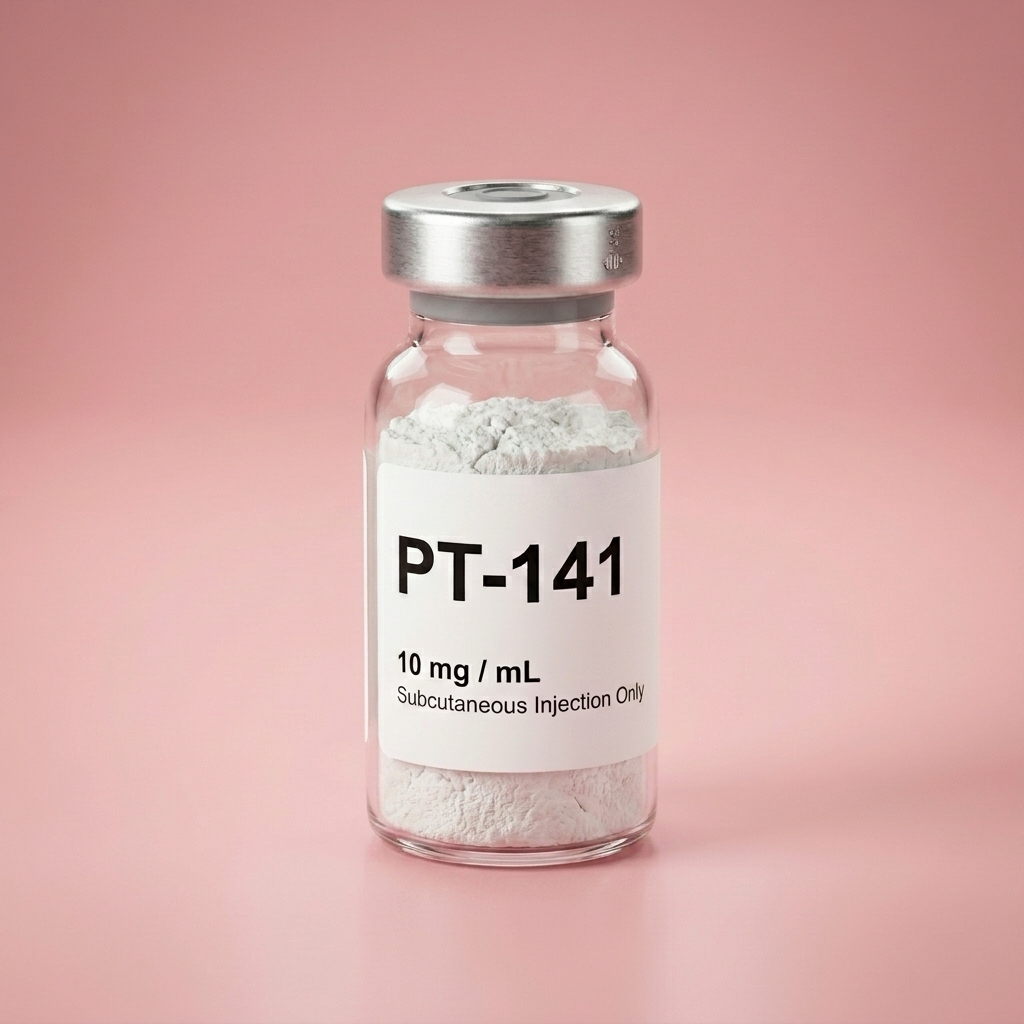
PT-141 (bremelanotide) is one of the only peptides in this space with FDA approval — for hypoactive sexual desire disorder in premenopausal women. The catch: the average patient in the Phase 3 trials saw a statistically significant but modest desire boost, AND the most behavior-relevant outcome (actual satisfying sex) didn't reach significance in either large trial.
YOU'LL LEARN, IN ORDER
- Is the science good?Yes, Phase 3 trials
- Does it work?Approved, modest effect
- The short versionTL;DR
- Should I take it?Honest answer
- Where this is from6 studies
How we got to that verdict.
You've probably seen PT-141 — also sold under the brand name Bremelanotide — mentioned on TikTok, Reddit, or in wellness communities as a kind of "libido shot" that actually works on the brain, not just blood flow. You've also probably seen people either swear by it or dismiss it as overhyped.
The truth is more interesting than either version. PT-141 is one of the few compounds in this space with real Phase 3 clinical trial data behind it — meaning it's been tested in large, controlled human studies, not just in a lab or a few anecdotes. But "it has real data" and "it does exactly what you're hoping for" are two different things. Let's walk through what the research actually shows, claim by claim.
The research journey
Medical research moves through stages: first scientists study a compound in a lab, then in animals, then in small groups of humans, then in large controlled human trials, and finally — if the evidence is strong enough — regulatory agencies like the FDA review it and may approve it. PT-141 (bremelanotide) has completed the full journey. It received FDA approval in 2019 7 for a specific condition: hypoactive sexual desire disorder (HSDD) in premenopausal women. That's a meaningful milestone. Most compounds never reach it.
That said, FDA approval answers a narrow question — does this drug work well enough, in a specific population, under specific conditions, to be sold as a prescription medicine? It doesn't answer every question you might have about whether it will work for you, how strong the effect will be, or how it compares to other options.
The approval was also granted despite some genuinely contested evidence — including the fact that the average patient in the trials didn't reach what researchers define as a "clinically meaningful" improvement in desire scores, even though the group average was statistically better than placebo. Those details matter, and we'll cover them honestly below.
Animal research is how all medical inquiry starts — aspirin, penicillin, and every drug you've ever taken went through this stage. But fewer than 1 in 10 animal-tested compounds ever make it through to regulatory approval for humans. PT-141 is past that stage — it's been tested in humans, repeatedly, in large trials.
The honest bottom line
PT-141 is better researched than almost anything else in the peptide and libido space — it has two large, controlled human trials behind it and FDA approval for a specific use.
But "FDA-approved" shouldn't be read as "definitely works for everyone" — the average patient in the trials saw a statistically significant but modest improvement in desire scores, the most concrete behavioral measure (actual satisfying sex) didn't reach significance in the largest trials, and the evidence base comes entirely from one manufacturer with no independent replication yet.
If you're a premenopausal woman with genuinely low sexual desire that's causing you real distress, PT-141 has meaningful evidence behind it and is worth discussing seriously with a provider. If you're outside that specific population — or expecting a dramatic, reliable effect rather than a real but modest one for many users — the evidence should set realistic expectations before you decide.
Sources
- RECONNECT-1: Phase 3 trial of bremelanotide for HSDD in premenopausal women(2019)
- RECONNECT-2: Phase 3 trial of bremelanotide for HSDD in premenopausal women (parallel to RECONNECT-1)(2019)
- Phase 2b dose-finding trial of bremelanotide (n=327; satisfying sexual events significant at p=0.018)(2016)
- 52-week open-label extension of bremelanotide (n=684, ~40% completion, no control group)(2020)
- Pre-specified responder and MCID analysis of pooled Phase 3 data (~58% benefit vs ~36% placebo)(2020)
- Integrated subgroup analysis of Phase 3 data — efficacy across age, BMI, testosterone level(2020)
- FDA approval of Vyleesi (bremelanotide) for premenopausal HSDD(2019)
Some links above point to PubMed search results rather than direct study pages where the original publication wasn't indexed (mostly for the company press releases that were never peer-reviewed). When that happens, the search query is scoped to the specific compound and topic.