
START HERE
Read this in 60 seconds.
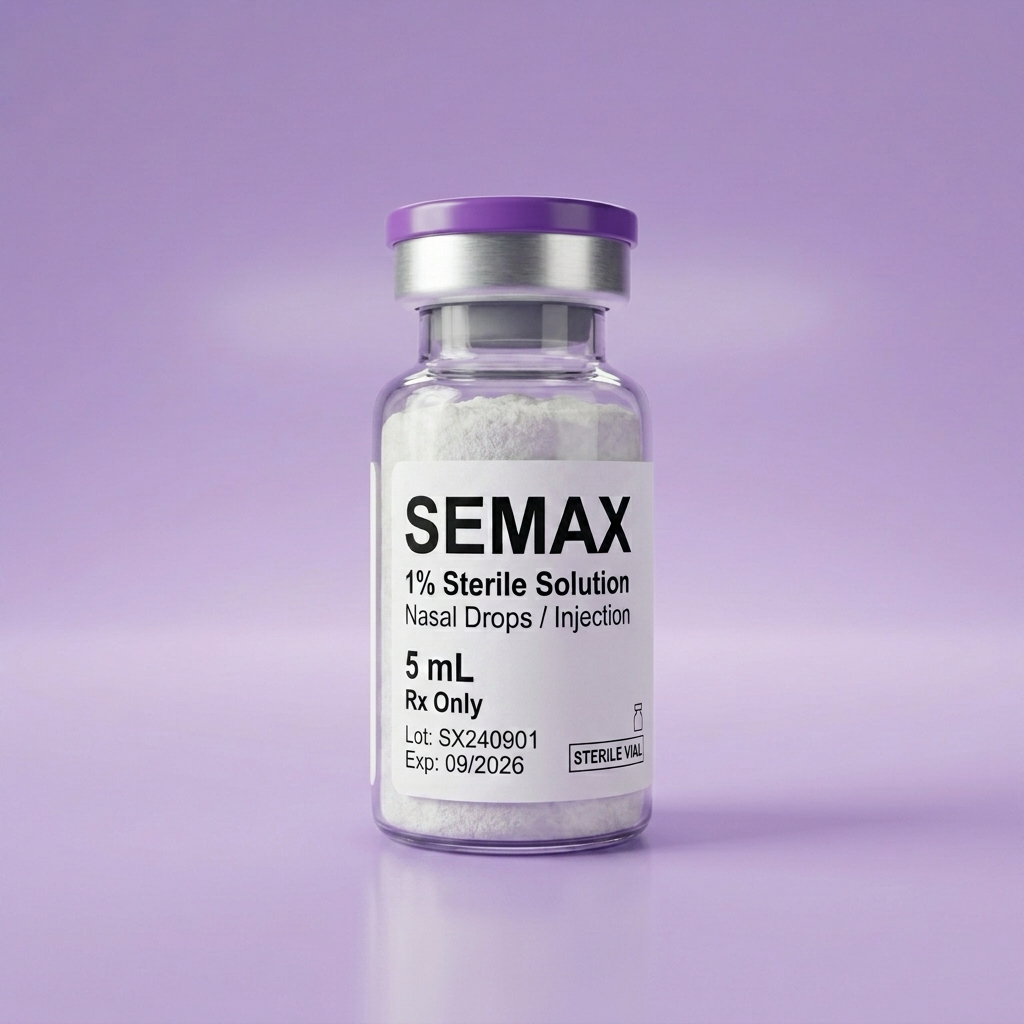
Semax is a synthetic peptide derived from a stress-response hormone, originally developed in Russia for stroke recovery and now widely promoted in nootropics communities for focus, memory, and mental clarity. The biological story is more coherent than most peptides at this stage. But every human study was conducted in stroke patients by researchers tied to the compound's inventors, and the one trial in healthy people scanned brains without testing whether anyone actually thought more clearly. Promising, not proven.
YOU'LL LEARN, IN ORDER
- Is the science good?Stroke + rats only
- Does it work?Promising, not proven
- The short versionTL;DR
- Should I take it?Honest answer
- Where this is from12 studies
How we got to that verdict.
You've probably seen Semax described as a Russian nootropic that "supercharges" focus and memory — something biohackers swear by and researchers are quietly excited about. You've also probably seen the counterargument: that almost all the research is in rats, done by the people who invented it, and published in journals most Western scientists have never heard of.
Both of those things are mostly true, and neither one tells the full story. Let's walk through what the research actually shows, claim by claim, so you can decide what to make of it.
The research journey
Every medicine that's ever made it to a pharmacy shelf traveled the same road: lab dish, then animals, then small groups of humans, then large human trials, then regulatory review. Semax sits at the small-human-trial stage — but barely, and with caveats. The bulk of published research is in rats 4 5 6. There are a handful of human studies, but they were all conducted in stroke patients recovering from brain injuries 1 2, not in healthy people trying to sharpen their focus. The one exception is a small brain-imaging study in 24 healthy volunteers 3 — and it didn't measure whether anyone actually thought more clearly. Semax has not been approved by the FDA or any major Western regulatory body. It is approved in Russia for clinical use in stroke and brain injury contexts.
Animal research is how all medical inquiry starts — aspirin, penicillin, and every drug you've taken went through this stage. But fewer than 1 in 10 animal-tested compounds ever make it through to regulatory approval for humans. That's not a reason to dismiss animal results. It's a reason to treat them as a promising start that needs confirmation, not a finished proof.
The honest bottom line
Semax has a more coherent biological story than most compounds in this space — there's a plausible mechanism, there are human studies, and there are licensed providers with real clinical experience.
But every human study was conducted in stroke patients by researchers closely connected to the compound's inventors, and the one study in healthy people didn't test whether anyone actually thought more clearly.
If you're drawn to Semax for focus, memory, or mental performance, you're making a bet on a promising but unproven compound — and that's worth having an honest conversation about with a provider who can weigh your specific situation and goals.
Sources
- Semenikhin et al. — Effect of Semax on stroke recovery in 110 patients (non-randomized, unblinded clinical trial)(2008)
- Gusev et al. — Semax in post-stroke rehabilitation: 7-month functional independence and blood BDNF outcomes(2018)
- Kolik et al. — Default mode network response to intranasal Semax in 24 healthy adults (resting-state fMRI; placebo-controlled)(2021)
- Shadrina et al. — Semax modulates BDNF gene expression in rat hippocampus and frontal cortex (intranasal, single dose)(2010)
- Dolotov et al. — Semax enhances BDNF and TrkB expression in rat hippocampal neurons(2006)
- Medvedeva et al. — Semax improves passive avoidance learning in rats (behavioral memory test paired with BDNF measurement)(2014)
- Stavchansky et al. — Genome-wide gene expression changes in rat brain following Semax administration after induced ischemia(2011)
- Filippenkov et al. — Semax modulates inflammatory and neurorestorative gene networks in rat ischemic brain(2020)
- Ashmarin et al. — Original characterization of Semax as an ACTH(4-10) analog with nootropic activity(1997)
- Potaman et al. — Pharmacokinetics and stability of Semax following intranasal administration in rats(2001)
- Kaplan et al. — Effects of Semax on dopaminergic and serotonergic neurotransmission (preclinical)(2002)
- Myasoedov et al. — Semax in clinical neurology: review of early Russian clinical experience(1999)
Some links above point to PubMed search results rather than direct study pages where the original publication wasn't indexed (mostly for the company press releases that were never peer-reviewed). When that happens, the search query is scoped to the specific compound and topic.