START HERE
Read this in 60 seconds.
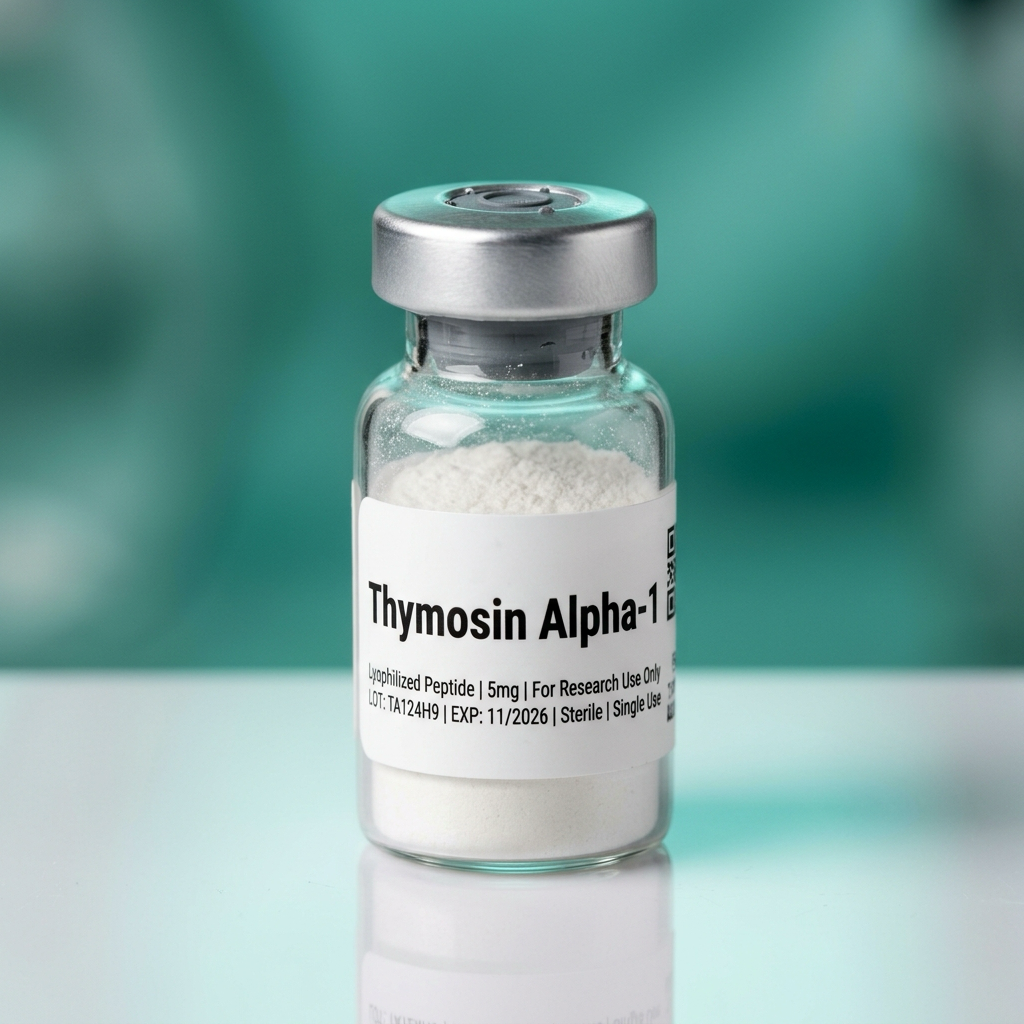
Thymosin Alpha-1 has more human trial data than nearly any peptide in this space. It's regulatory-approved in Italy and parts of Asia for hepatitis B, but never received FDA approval despite multiple attempts. The scorecard is geography-dependent: real evidence in Asian hepatitis B trials, weaker in Western ones, and almost none for the general immune-strengthening uses people are most interested in today.
YOU'LL LEARN, IN ORDER
- Is the science good?Yes, but mixed by region
- Does it work?Real for hep B, unclear for the rest
- The short versionTL;DR
- Should I take it?Honest answer
- Where this is from16 studies
How we got to that verdict.
You've probably come across Thymosin Alpha-1 in a wellness forum, heard about it from someone fighting a chronic infection, or seen it described as a way to "supercharge" your immune system. You've also probably noticed that some sources sound almost religious about it while others dismiss it entirely. Neither reaction is quite right.
Thymosin Alpha-1 has a genuinely interesting research history — more human data than most peptides, some real wins, some real failures, and a story that looks very different depending on which disease, which population, and which decade you're reading about. Let's walk through what the research actually shows, claim by claim, so you can decide what to make of it.
The research journey
Thymosin Alpha-1 sits further along the research journey than almost any other peptide you'll encounter in wellness spaces. It has been through large, well-designed human trials — including Phase III studies (the kind required before drug approval) involving hundreds of patients across multiple countries. It has received regulatory approval in several countries, including Italy and parts of Asia, for specific uses like hepatitis B treatment.
In the United States, it never received FDA approval despite multiple attempts, partly because the most rigorous Western trials produced weaker results than the Asian trials that preceded them 4 5, and partly because the diseases it was tested against — hepatitis C, for example — were later solved by completely different drugs.
So the honest answer to "where does it sit?" is: fully through the human trial stage for specific diseases, with a mixed scorecard. For the general immune-strengthening uses that most people are interested in today, the evidence is thinner — mostly smaller studies and real-world provider experience rather than large controlled trials.
Animal research is how all medical inquiry starts — aspirin, penicillin, and every drug you've taken went through this stage. But fewer than 1 in 10 animal-tested compounds ever make it through to regulatory approval for humans. That's not a reason to dismiss animal results. It's a reason to treat them as a promising start that needs confirmation, not a finished proof.
The honest bottom line
Thymosin Alpha-1 has more legitimate human research behind it than nearly any other peptide discussed in wellness and integrative medicine circles, and for patients with chronic hepatitis B — especially in Asian populations — the evidence of benefit is real, even if it's not conclusive by modern standards.
For the uses most people are actually interested in, including general immune strengthening, resilience, and recovery from common chronic infections, the evidence is honest-to-goodness promising but not yet proven: there are plausible mechanisms, consistent provider reports, and disease-specific data that support the biological story, but the clean, controlled human trials that would confirm the general use case haven't been done.
This is worth discussing with a provider who can assess whether your specific situation fits the clinical picture where evidence is strongest.
Sources
- Sherman et al. — RCT of Thymosin Alpha-1 for chronic hepatitis B in Taiwan (n=98, 41% vs 9% viral clearance)(1998)
- Japanese trial of Thymosin Alpha-1 for hepatitis B (n=316, 22.8% e-antigen seroconversion at 72 weeks)(2003)
- Pooled analysis of 8 RCTs of Thymosin Alpha-1 + lamivudine for hepatitis B (n=583)(2009)
- Phase 3 Western trial of Thymosin Alpha-1 for hepatitis B (n=97, double-blind placebo-controlled, 14% vs 4% response)(2002)
- Phase 3 trials of Thymosin Alpha-1 for hepatitis C (failed to show benefit over standard treatment)(2008)
- Chinese retrospective study of Thymosin Alpha-1 in lung cancer post-surgery (n=5,746, improved 5-year survival)(2018)
- European Phase 3 trial of Thymosin Alpha-1 + dacarbazine for melanoma (n=488, 64 centers; survival trend, narrowly missed primary endpoint)(2010)
- Italian Phase 2 trial of Thymosin Alpha-1 for sepsis (immune cell recovery)(2013)
Some links above point to PubMed search results rather than direct study pages where the original publication wasn't indexed (mostly for the company press releases that were never peer-reviewed). When that happens, the search query is scoped to the specific compound and topic.